

When Executive Presence Stops You From Showing Up Authentically
For many women, getting dressed used to be simple. Not because it was easy, but because the rules were clear. There was a template, a uniform, a version of “professional” that promised safety, credibility, and belonging if you followed it closely enough. But somewhere between leaving corporate roles, starting businesses, working from home, and stepping into leadership on our own terms, those rules quietly disappeared. And in their place came this vague, unsettling directive to “just be authentic.”
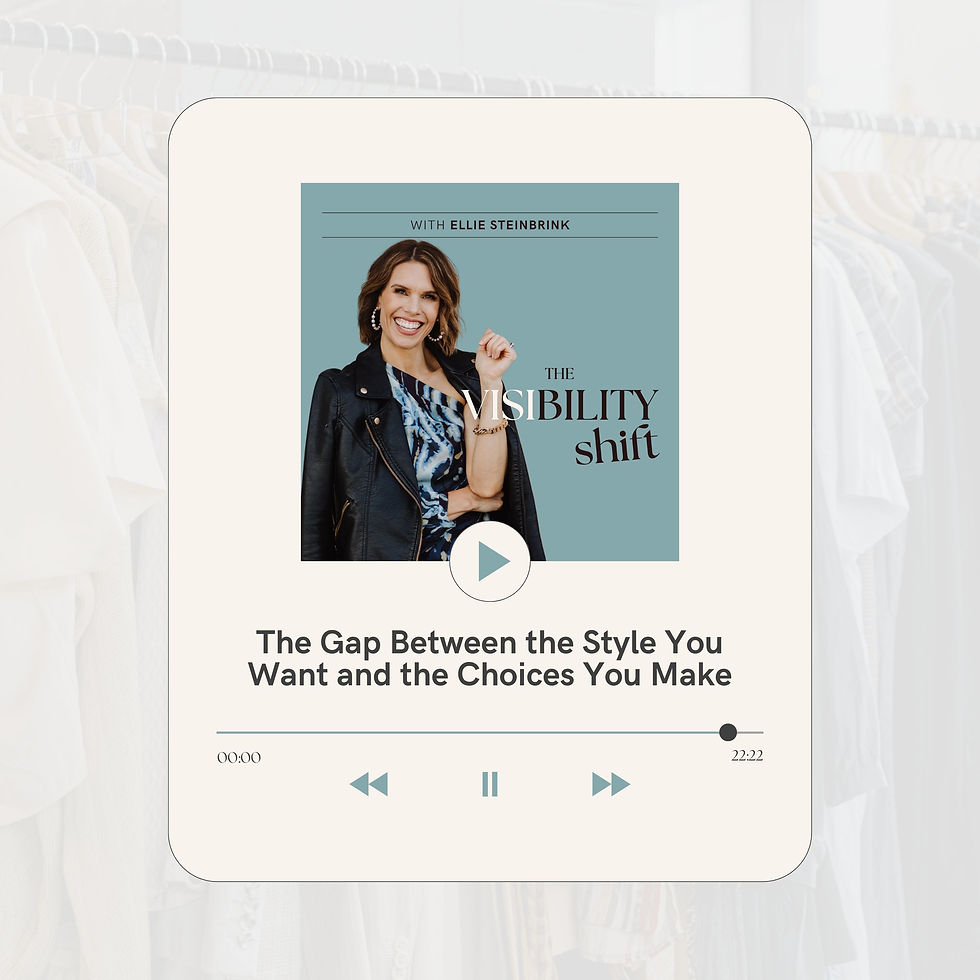
In this episode of The Visibility Shift, I explore why that instruction feels so confusing (and sometimes downright unsafe), especially for women who were trained early in their careers to prioritize executive presence over individuality. I unpack the tension between performative style and authentic style, ask where you might still be dressing to appease, fit in, or avoid risk, and define what it would mean to choose alignment instead.
Subscribe on Apple Podcasts or Spotify
2:25 - The unspoken rules many women are still following long after the workplace that created them is gone
4:06 - Why authenticity feels liberating in theory but terrifying in practice
6:53 – The meaning of executive presence in today’s work environment
8:08 - The hidden comfort of templates (and the quiet cost of relying on them)
10:48 – What makes authentic style so hard to nail down and what it takes to find yours
14:44 - How to bridge the gap between performative, dress-for-success style and authentic style
16:41 - Why being seen clearly matters more than being universally approved
18:57 - A reminder you may want to return to the next time playing it safe feels tempting
Mentioned In When Executive Presence Stops You From Showing Up Authentically
Full Transcript
Welcome to The Visibility Shift, the podcast where style becomes your most powerful strategy for being seen, standing out, and leading boldly. I'm Ellie Steinbrink, stylist and personal brand coach, and if you've ever thought, "My style just isn't working anymore," take this as your sign. You're ready for your next level. And instead of launching into a panicked shopping spree, what you really need is a strategy. A style strategy that reflects where you're headed, not who you used to be or who you think you need to be to fit in.
Because when your style aligns with your brand and your vision, everything shifts. You lead with more presence, you attract the right opportunities and clients, and you fully step into the woman you're becoming. Because showing up as yourself, that's the most strategic thing you can do. Now let's get visible.
Welcome back to another episode of The Visibility Shift. Many of the women that I work with have come from corporate careers, and when they became a business owner, the cues they once had about how to dress are just completely gone. If you've started your business in the last five years, you've likely cozied up to an athleisure wardrobe and then felt totally clueless about what to do when getting dressed for in-person events or client meetings.
Our dress codes for work, whether you are working from home, running your own business, or still in an office with a small team, have completely changed. Not just the fact that we have gone more casual, but the fact that what we once valued in terms of dress is changing. What was once valued was dressing for success or executive presence, and now we are seeing a trend towards authentic leadership and authentic presence and style.
In this episode, what I want to talk about is this transition from an overly standardized dress code rule to now this authentic dress code rule that feels very loose and hard to pin down. Especially if you're an entrepreneur who doesn't necessarily have a workplace setting the tone for you. We'll talk about what it means to show up in a more authentic way and also why we feel so married to this opposite idea, which is just to look nice or polished or professional.
As always, I will give you some practical tips about how you can start practicing this and start working towards a more authentic style. Let's start by going back a few decades to the workplace environments we all probably remember starting our careers in. If you're a woman in your mid-40s like I am or above, you are probably going to be able to better relate to what I'm talking about.
Back then, dressing in the workplace was so different than it is now. No talk of individualism and no talk of authenticity. You just followed suit, and you took cues from who was around you, especially those higher up than you.
You did what they said. I remember getting feedback on my clothes and what I was wearing and whether or not something was appropriate or professional enough. While I worked in an advertising agency, remember, if you're new to me, I worked 20 years in a marketing career, I worked in an advertising agency, which is traditionally a very individualistic and creative environment. However, my role was in client service, so it required me to fit a mold that was set by my clients.
Many of my clients were in a financial space, so very traditional and formal. I'm not the only person who has gotten feedback in my career. Many of my clients tell me they have gotten feedback from managers about what to dress and what not to wear.
There was a really strict set of guidelines to follow if you wanted to be taken seriously and perceived as professional. As someone starting my career, like many of my clients were a few decades ago in my 20s, that was important to me, to follow suit, follow the rules, and do what I saw others above me doing.
So it's no surprise to me that when I work with women now in their mid-40s, they're shackled by dressing the way they were taught in their corporate careers. To do anything else feels downright awkward and wrong. Fast forward to now, we are in an era where authentic leadership is front and center.
It's a topic that people are seriously discussing. I listen to so many podcasts across the board, whether it's corporate-geared podcasts or entrepreneur-based podcasts, that are talking about this idea of authenticity and what it means to show up in an authentic way. Everyone is trying to figure this out and trying to embrace it, yet it still feels like it's not safe for some to cross this bridge.
Am I right? What I have noticed is that authenticity has really just become a huge buzzword. It gets thrown around a lot, but I am honestly seeing women, especially the ones I work with or talk to in my space, struggling with how to apply it or even act on it.
We’ve got a couple of different spectrums of people. We've got the people in terms of like thinking about showing up in an authentic way. We've got one end of the spectrum where women are saying, it kind of harkens back to this group I just mentioned, where we have been playing apart so long that we literally can't define what it would mean for us to show up authentically. It was never even a consideration because they started their careers in such a different era.
Beyond that, taking such a risk felt too vulnerable and too much of a jump away from what would make them comfortable.
So that’s one camp. There’s a lot of fear there. There’s a lot of old rules holding them back in this idea that, whoa, that’s not safe. Then we’ve got other people on the other end of the spectrum, and I feel like they tend to be younger, but that’s not always the case, that are like, "Hey, this is me. Take it or leave it. You don’t like that I wear halter tops or that I wear flip-flops to work? Well, screw you. I don’t feel respected because you can’t respect me for who I am." That’s like the other extreme of authenticity.
Somewhere between these two extremes, I feel like we need to find a balance. A balance between the group that’s saying, "I am who I am, so take it or leave it," then the other camp of "There’s no way I’m letting anyone see who I actually am. I just feel better and safer playing this part." I’d really love to be able to explore this middle ground where we can show our individuality with confidence, and the knowledge that it will lead to richer connections. It will lead to better leadership. It will lead to better mental health, if I’m honest, when we’re not faking it.
But for today, I want to dive a little bit deeper onto the one group who I mentioned that are probably in their 40s and beyond, that are in the "It’s not safe for me to be authentic camp." Or "I just don’t even know what that would mean because I’ve been trained so long that that just isn’t even a thing."
This is someone who likely had a career in corporate before the days of authentic leadership was ever even introduced. One thing I know to be true is that in those days, in this old workplace environment, executive presence was king. What exactly is executive presence? Because I know it’s getting redefined now in this heart of authenticity. But when I was going through my early days in my career, it was an entirely different thing.
As I started to do some research and tried to find a definition, it was really difficult to nail down what exactly executive presence meant or how it was defined. But in my research, I concluded a few key points. Number one, it’s not a trait. It’s a skill to be learned. So it’s something you can cultivate. Then there is a showmanship around it.
Executive presence is the combination of confidence, communication, and appearance that signals leadership potential. It’s really like this ability to look and sound and act like someone in charge. So you’re projecting authority, you’re projecting credibility, composure, swagger, charisma, so that others trust your leadership. Now, I don’t know about you, but this definitely paints a picture of one personality type.
There’s not a lot of room for different perspectives or different personality types in this definition. It basically says there’s only one archetype of a true leader. If you aren’t that or can’t adopt those skills or qualities, well, you’re out of luck. You know, as much as I hate the term executive presence, and we’ll get into that, the thing I will say about it is that there was a template to follow, wasn’t there?
And gosh, don’t we all love a template? At least I do. I’ll just speak for myself. It’s just, it’s so easy to check the box, right? All you have to do is look around you and copy and paste. You can learn these skills. You can get the clothes. You can acquire the watch, the suit, the bag, whatever that makes you that person. You can do all these things and you’ll be golden.
I mean, I remember so distinctly I was in college. I was interning at a law firm. Of course, I was the marketing specialist. I never went into law. But I was shocked when my first day on the job, I noticed that literally everyone was wearing suits in only neutral colors. It was black, blue, maybe navy, brown, gray. That’s it.
Every person, woman or man, looked exactly the same. It wasn’t like skirt suits. There were a few skirt suits, but mostly it was women wearing a man’s suit. It was all like they were wearing a collared shirt. It was just so consistent. It was a way for them in that law firm to ensure a professional look for their clients, right? They had a standard to set.
I will never forget my immediate thought was, "Oh my gosh, I can’t do this." Thank God I was just an intern. So I didn’t need to really conform to all of their rules. I wasn’t client-facing. But I remember thinking I cannot squash my creativity or who I am to fit in with this dress code.
So I guess it’s pretty clear that from an early age I had a problem with fitting in. But this isn’t the template anymore, is it? I mean, maybe in some workplaces it has been slow to die, but this idea of executive presence is now becoming the bad guy, or at least we’re working to redefine what it means.
The thing that goes against this executive presence, or at least the old definition of it, is the thing that goes against our new workplace value of being authentic. What does it take to have authentic leadership, much less an authentic style, given that we’ve all been trained in showing up with an executive presence from an early age?
And here’s the thing that I think makes authentic style so difficult and wiggly and hard to nail down: there is no template. There is no box to check. The reality is that authentic style can only be solved by you. Not ChatGPT, not a coach, not a therapist, not even going to a Nordstrom store and having a stylist help you there. They cannot solve your problem of how to define an authentic style.
What it does take is to get curious. Some questions that come to mind for me when I think about curiosity around this topic are, where have I been hiding myself to appease others? Another question, where have I been believing that my true self isn’t good enough or isn’t professional enough? Where have I been conforming myself to fit into a mold?
And that might sound like wearing clothes you don’t love, but you know will help you fit in or play the part in whatever industry or role you are in. Or maybe the question is, where have I been taking the easy route, like checking the box and copying what I see around me? Assuming, well, if they’re successful in their space, if they are leaders in the space, maybe they know best.
Lord knows I have been tempted to do this on so many occasions in my life, not just in my style. I’ve told stories here on the podcast about feeling like I needed to emulate the style of groups I was in or events I went to. But just in how I should run my life or run my business, I have this tendency to think that others know best.
The reality is that finding your true self, your true style, about what makes you special or what makes you different requires an incredible level of honesty. It requires shedding old beliefs and expectations. I can speak firsthand about how difficult this can be, to look at yourself honestly in the mirror in an attempt to get back to the core of who you are.
In fact, I was in a therapy session earlier this week, and I wanted to get some perspective from my therapist about our last several months of working together. I asked her what my biggest blind spot was, what she saw as the biggest theme around the conversations that we had been having. She said, self-abandonment, hands down.
Now, this felt pretty crappy. If I’m being totally honest, it was not a surprise. But it also didn’t feel great, especially since one of the core messages of my business, of this podcast, is about coming back to yourself. It is about authentic style. It is about being you. It isn’t about self-abandonment.
Even though I knew the answer, I followed my original question to her with another question, and that was, what’s the opposite of self-abandonment? And she said it’s fully being yourself. And there it was, the thing that’s hardest to do, right? The thing that even I, who sits here and I think I do a pretty good job of being authentic in my style, but clearly it’s still a work in progress in other areas of my life.
The thing, being true to yourself, I think at an early age, somewhere along the line, I believed that that wasn’t safe, that performing and achieving and people pleasing, that was safe.
Following in line, playing by the rules, being nice, being kind, being accommodating, smiling—that was the safe path. Maybe you had a similar experience growing up, and then those patterns continued into my workplaces, and that’s why we’re having this conversation here. So where do we go from here? How do we bridge this gap between performative style and authentic style, or executive presence or dress-for-success rules versus authentic style? Especially for those of us who are programmed to believe that that’s not safe. “Don’t tread in that water.”
The first step I have for you is just simply awareness. You’re probably going to get tired of me saying this because this is always where I start. Awareness is so huge. It’s where I start with all of my clients. Some people can’t understand why, as a stylist, I would not immediately start with shopping and styling. It’s because all of those efforts will be for naught if we don’t address some of these underlying issues, these underlying beliefs and expectations about how we should show up.
This whole conversation today is a lot of beliefs and expectations about how we should show up. Because sometimes we don’t even realize what we are doing, how we are operating, until we start getting reflective. The good news is that awareness is what we’ve been doing today here together on the podcast, trying to catch yourself in your old thinking, where it may be off, where it may not be helping you anymore, where it may be leading you to self-abandon or lack self-trust.
The second step to making a real change toward authentic style requires bravery. I have to give a shout-out to all my clients. If any of you are listening, you know I love you. Because each and every one of them possesses a similar trait. They have courage. They had courage to see where they were following a template or trying to fit in. They allowed themselves to choose what felt most aligned. They allowed themselves to be seen, even though they felt scared. They valued uniqueness over fitting in.
This is the core of authentic style. Uniqueness isn’t just about standing out. It’s about allowing people to see you so that they trust you, so that they can know you, so that you can be believable. No one promises this is going to be easy. I’m the first to tell you that. In fact, it will be pretty vulnerable to start showing up in a way that’s aligned instead of performative.
It’s really hard to know you may stand out versus fade into the background, right? Because it draws attention to you. It’s hard knowing you may not get praise or compliments. You might even get a side eye or two. Now, I will say that none of my clients have gotten side eyes, but I think you know what I mean. Following a proven path leads to these “Oh, you look like a boss babe.” It’s a dangerous path to go down because you can get a lot of good feedback, but it may not be aligned.
It’s hard to know you won’t look the same as everyone else. It brings back all those fears we had when we were teenagers and had the thought of wearing something new or different to school. “Does anybody remember this?” That fear of knowing everyone else was wearing the same brands or the same items. There was definitely a code of what was cool or not cool. This fear of going against that was like, “Oh my gosh, what will people say? Are they going to judge me? Are they going to think I’m not cool?”
And yes, it’s going to be hard to have an authentic style. But it’s not harder than the opposite, which is continuing to perform and be someone you’re not. In that world, we have a whole lot of sameness and fakeness. Deep down, none of us wants this. We don’t want it from the person across from us. We don’t want it from the person who we’re listening to on stage. We don’t want it from the clients we choose to work with.
What I’ve learned is that you become a shell of yourself when you let others rule in your life. When you become so focused on others, you lose sight of yourself. Over time, it breeds all sorts of negative emotions—resentment, fear, sadness. As we know, our emotional state can impact our physical state. All this striving and trying to be perfect and check the boxes is doing us no good. That’s true in our style.
So today, as we are beginning a new year, let’s commit to not checking boxes. Let’s commit to not following a template that worked for others or worked in the past, but no longer does. Let’s not mimic what we see around us in our style, even if that feels easier because we don’t know what else to do. Let’s not fall into the trap that looking or sounding or being one way is the ultimate path to success.
Instead, believe that being who you are is the ultimate path to connection, freedom, joy, belonging—all of the things we really want. Let’s commit to discovering what’s true for us, even though it’s hard. Commit to finding what is a true representation of me, of you, all the while knowing it will feel awkward, it will feel scary, it will feel vulnerable, but that doesn’t make it wrong. In fact, in my opinion, it just makes it worthwhile to pursue.
I would say bookmark this episode because it might be one you need to come back to time and again when you’re feeling a little scared to show up fully as yourself, to choose an outfit that doesn’t feel like it falls in line with what you’ve seen in your industry, or to take a chance on yourself. Come back. Be encouraged by these words that that is not the path you are going on any longer.
If today resonated with you, I’d love for you to share with another woman in your life because we all need to hear this. Especially if you’re in this phase of life, like I am, this mid-40s, where we’ve lived another version of a workplace, of our careers, where it was a much different way of being, and we’re now relearning how to do this.
The other thing I’ll say is if you’re being called to go deeper into this work or finding a style that feels truly authentic and aligned, I’d love for you to consider working with me. I have options to work in a one-on-one setting or in a group program, and if you go into the show notes, there will be links to learn more about each of those programs, as well as to join a waitlist for 2026.
But until then, reflect on what would change if you committed to showing up more as yourself in your business, in your networking events, in your speaking engagements and meetings. If you committed to doing so, what would change? I’ll give you a hint: whatever comes to mind first, that’s probably the thing you should pay most attention to because it’s probably the hardest thing.
Trust that intuition. Trust that even though it’s scary, it is taking you in the right direction. I will be sitting here with you every week, encouraging you and cheering you on. With that, I send you all my love, and I’ll see you in the next episode.
Thanks for joining me on The Visibility Shift. If something in today's episode made you pause, rethink, or gave you permission to stop playing small, it would mean so much to me if you'd leave a review at ratethispodcast.com/visibilityshift.
If you're ready to stop second-guessing and start showing up as the leader you are from the inside out, The Visibility Edit is where that shift begins. Head to elliesteinbrink.com to learn more and join the next round. Because the next version of you, she's not waiting for permission. She's waiting for you. Let's make it visible.


Comments